Showing posts with label Marketing. Show all posts

Thursday, September 11, 2014

How iPhone 6 Marketing Will Change your Brand?

The day of reckoning is upon us, the long awaited iPhone 6, iOS 8 and the iWatchwere announced today. Let’s cover the basics of what was announced, and how it could potentially fit into your marketing mix for Q4 2014 and heading into 2015.
For starters – the iPhone 6 comes in a 4.7 inch screen and a 5.5 inch screen, clearly larger than the current 4 inch version. The new wave of ‘phablets’ continue to bring quality experiences to consumers who not only love bringing their mobile devices on-the-go, but also want to use it at home for more long usage.
iPhone 6 / iPhone 6 Plus / iWatch:
The new devices allow for a more connected ecosystem of devices that you will see continue to expand over the next decade. For now – at the very least, you will see larger screens drive more time spent on mobile phones, stronger engagement, richer mobile ads and a rise in video consumption. It’s something that’s been noticeable with the Galaxy S5 vs. other android devices, and you can imagine given the affluent demographic that Apple reaches, those numbers will be even stronger on the new iPhones. The iWatch becomes an interesting piece to future marketing tactics as it will be an extension to your products.
App Extensions:
Perhaps the biggest announcement in iOS 8, app extensions will allow for customization and open the iOS ecosystem to 3 parties. This includes custom interaction in the notification center, sharing extensions for other apps to share content and others including 3 party keyboards, etc... What does this mean? Imagine being able to tap into instagram’s filters while in the pinterest app or sharing content from Safrai to your Facebook app without actually opening the app. Or even imagine being able to buy something on the whim from a push notification without actually entering the app itself. These are some simple cases, but you can imagine the seamless experience apps will be able to offer now and the user experience people will get to enjoy.
Apple Pay:
ApplePay is Apple’s new payment system that will allow users to seamlessly charge payments with their current credit cards via NFC and Touch ID scanning. Apple Pay also gives the opportunity for developers to allow one-touch payment processing at checkout and using your TouchID. Apple says more than 200,000 merchants will support the platform. This feature significantly reduces the barrier to logging in, making a purchase or any other behavior that requires people to input a large amount of information. Now the same information (e.g., credit card) can be stored and authorized using a person’s fingerprint — leaving significantly less friction and less opportunity for abandonment. The key thing to note here is Apple will not share any personal information (address, credit card info, etc…) with the merchant.
So what does this all mean for marketers? It continues to be a huge push into the era of big data, harnessed by the power of an integrated ecosystem and connected devices. To understand this new age of technology and how it affects marketing, it’s important to look at a few key factors:
1) There’s a tipping point of consumer usage with the majority of time spent now on phones, phablets and tablets
2) Privacy is always Apple’s top priority, but you imagine marketers will find loopholes to get more information on how consumers are using devices for both online purchases and now in the physical world
3) These devices are becoming the most trusted piece of a person’s life – now most notably as apple tries to replace credit cards and wallets
4) App usage continues to grow as do connected devices (cars, watches, wearables, etc..) – app extensions will seemingly make things smoother, and tracking media dollars now becomes more difficult than the standard world of cookies allowed. New IDs (Fingerprinting, Device IDs, etc..) should be a key to your cross-device marketing. And ensuring your app is seamlessly integrated to the new iOS 8 will separate winners from losers in 2015.
Given these 4 important factors, why would mobile NOT be an important piece of your marketing mix? Consumers are always ahead of the curve, but the wealth of data can help discover HUGE learnings for your brand. After all, the majority of purchases are still made in physical stores, with much of that initial research and product learning being done in the digital world. Mobile data is the key to bridging all the gaps in your marketing funnel.
Products like Venmo, Uber and Seamless have already proven the intuitive nature of power buyers, but now Apple is allowing a much larger adoption. What do wesee here at Pivmo possible in 2015? We see opportunities for higher impact on bigger screens, real-time messaging to drive impulse purchases - based on triggers such as location, context, social chatter, buying habits and relevancy. We see the opportunity for mobile being the most influential data source to understanding how consumers interact with all channels. We see video consumption on the rise, ultimately powering brand dollars. And finally, we see brands continue to explode through the power of mobile innovation and marketing winning over the new wave of consumers.

Monday, April 14, 2014

Lifecycle Marketing

33

Lifecycle Marketing is a seven stage system in your perfect customer experience. It is comprised of basic strategies integrated into a single, self-sustaining process. Companies and salespeople that implement lifecycle marketing principles through affordable, easy to use automation technology are in the best position to grow, nurture and retain valuable customers.


1. Attract Traffic - Attract leads to your website with great content like ebooks, infographics, research reports, webinars and blog posts.

2. Capture Leads - Encourage leads to sign up to receive your content, Be sure to include opt-in language in your web form.

3. Nurture Prospects - Create a consistent campaign of useful information and offers with automated, personalized follow up messages.

4. Convert Sales - Turn Browsers into buyers with e-commerce tools and a wel defined lead management strategy.

5. Deliver and Satisfy - Fulfill your commitments on time, then provide additional value that surprises and delights customers.

6. Upsell Customers - Develop a long term strategy, tactics, products and services to help generate additional sales and recurring revenue over time.

7. Get Referrals - Encourage referrals bu creating incentives for customers and partners.
It seems obvious and easy right? On the surface there are no secrets in lifecycle marketing. Small businesses have practiced this concept for thousands of years.

The thing is that most of us do not have an automated system to help us with each stage and so we are so busy attracting traffic, capturing leads, nurturing prospects and converting the sale that by the time it comes to step 5 "deliver and satisfy" we are out of business and need to get back to step 1 to stay in business. The truth though is that there is more business in your existing client base than in attracting new traffic that does not know you yet.

The real value of lifecycle marketing comes from integrating the individual building blocks of your plan into a single system.

[Source]

Sunday, April 13, 2014

How to rebrand: 19 questions to ask before you start

“The greatest enemy of knowledge is not ignorance, it is the illusion of knowledge.” Stephen Hawking

Companies will at some point come to that milestone known as “the rebrand.” For some, it happens early on once they’ve discovered who they really are while with others, it occurs after many years of having grown (or outgrown) their brand.

Then and Now

You’ll discover that some brands go along an evolutionary track that one could basically follow. (Personally, I am not a fan of the current Pepsi logo and consider the legacy and heritage was tossed out the window with the current logo, whereas Coca-Cola has done an amazing job of maintaining and refreshing their brand.)

Others have made a change that was a disastrous departure that resulted in a complete about-face within a two-week window:


And while a brand is so much more than a company’s logo, the logo is one of the key ambassadors to any brand. Hence the examples shown above.
There are various reasons, assorted catalysts or numerous “straws that can break the camel’s back” of the old or existing brand.
Yet, there are a number of questions that routinely come up when I start with a company to rebrand them. Here (in no particular order) are many of the questions that need to be answered to keep the brand:
  • true to itself,
  • meaningful so people take notice and care, and
  • powerful enough to make the difference everyone hopes for.

19 Questions That Every Rebrand Needs to Ask

  1. Why are we doing a rebrand?
  2. What problem are we attempting to solve?
  3. Has there been a change in the competitive landscape that is impacting our growth potential?
  4. Has our customer profile changed?
  5. Are we pigeonholed as something that we (and our customers) have outgrown?
  6. Does our brand tell the wrong (or outdated) story?
  7. What do we want to convey? To whom?
  8. Why should anyone care about our brand?
  9. Have we isolated exactly who should care about our brand?
  10. Have their needs, or the way they define them, changed?
  11. Are we asking our customer to care more about our brand — and what it means — than we do?
  12. Is our brand associated with something that is no longer meaningful?
  13. Is our brand out of step with the current needs and desires of our customers?
  14. Are we leading with our brand direction?
  15. Are we following with our brand direction?
  16. Is the goal of this rebrand a stepping stone (evolutionary) or a milestone (revolutionary) ?
  17. Will this solution work in 5, 10 and 15 years from now based on what we can anticipate?
  18. Have we assigned some committee to manage the project versus someone (or at most, two people) who is/are focused, inspired and can lead?
  19. If we were starting our business today, would this be the brand solution we would come up with?

More Than Skin Deep

Use the questions above to isolate why you rebrand to keep it from the “cliffs of insanity” (i.e., cliche crud like much of the current wave of homogenized, committee-drenched crap being put out by several of the big Fortune 100 corporations over the last few months).
Want to export this information to colleagues and any entrepreneurs you know? Here is the Slideshare version which has been viewed more than 100,000 times around the world.


Photo credit: Shutterstock
 
[Source]

Saturday, April 12, 2014

Logo Versus Brand – What Is The Difference?


Granted, yes, a logo design is part of your company’s corporate identity. However, the logo itself is not dependent on your company’s brand alone. So logo versus brand, what is the difference and when exactly does a logo become part of a brand? In order to answer this question, first let’s determine what the difference is between a logo and a brand.
What is a logo? In order to fully understand what a logo is, we must first identify the reasoning behind it and what its main purpose is. Several different aspects go into the design process of a logo. It must aim high to make it immediately recognizable while also inspiring admiration, trust, loyalty, in addition to an implied superiority. A logo is not used to sell, it is used to identify.
Paul Rand, one of the world’s greatest designers states that “a logo is a flag, a signature, an escutcheon, a street sign. A logo does not sell (directly), it identifies. A logo is rarely a description of a business. A logo derives meaning from the quality of the thing it symbolizes, not the other way around. A logo is less important than the product it signifies; what it represents is more important than what it looks like. The subject matter of a logo can be almost anything.”
What is a brand? The best way to describe a brand is to look at it as a collection of perceptions that customers and prospective clients have about your business. Although you do not have control over these perceptions, it doesn’t mean that you have no control over your brand. Controlling your customer’s idea of your brand can be defined by designing striking and impactful graphics that will convey your message. Using these same graphics on a consistent basis throughout the design of all of your marketing materials will help portray the right idea about your brand to your customers and clients.

What Aspects of Your Brand Do You Have Total Control Over?

Your Story – What are you trying to say about your business? Figuring out who you are, what you do, what makes you unique and separates you from everyone else, and who are your best clients? And then combining all of that information into an easy, straight-forward, and understandable story of your brand.
Your Logo – Your logo should be designed in a way that identifies your brand while also maintaining an attractiveness to your target customers and clients.
Your Visual Vocabulary – Your logo is only one piece of your visual communication tools. Visual Vocabulary is a combination of various other visual aspects. These may include but are not limited to background colors, palettes, and patterns. Others may include header designs, stock photos, borders, special treatments for buttons and special offers, product images, and font styles. In essence, Visual Vocabulary provides you with more tools to create stunning designs for your brand.
Specific Marketing Material – This includes business cards, letterhead, stationary, brochures, website, blog, and social media design such as your Twitter background and Facebook Timeline Cover. Each of these materials should maintain a consistent look and feel while also complementing each other.
So in conclusion, a brand is so much more than just a logo. It is the uniform way of telling your company’s story through unique and consistent design. This story will then stick in your client’s minds and their comments and buzz about your company will reinforce their perception about you, and the ideas that you want them to have about your business.

[Source]

Increase Profits from Your Marketing Campaigns

For most small business owners, having effective marketing campaigns that consistently produce favorable ROI's is more important than ever. Although that may seem rather obvious, the factors that contribute to profitable marketing or advertising campaigns may not always be as obvious. In this article I will review the steps that I use in my own business as well as my clients, to make sure marketing goals and objectives are met and the campaigns produce profitable returns. Hopefully they will benefit you and your organization as well.
Planning
Before any marketing campaign is even considered, you must determine what it is you want to achieve. As obvious as this question is, I frequently consult with many small business owners that do not even consider this when they begin their campaign. Many people assume that as long as you are spreading the word, you will get business from it, so it's all good. In reality it may play out that way sometimes, but often times it does not. Even if the campaign was profitable, it might've been more profitable with better planning and tracking.

Thinking in Reverse
I have a methodology that I practice in nearly every situation where a specific end result is desired, regardless of the topic. You start with exactly what it is you wish to achieve and then break down into the various incremental steps or milestones that would need to be achieved to accomplish that goal. In this particular scenario, let's say that a hair salon owner wanted 40 new customers per month. Let's simplify things to say 10 new customers per week. This shop has had its best marketing success using direct mail. They have found that approximately 50% of people who initially call actually show up for their appointment. Some people call for questions and pricing but did not make appointment while others make appointments but don't show.
So the bottom line is they need to generate 20 inbound calls per week to get 10 new customers. They have also determined that approximately 1% of the postcards they mail will generate a phone call. Therefore they need to mail 2000 postcards per week which will generate 20 calls and 10 new customers. As a side note, without having this important conversion statistics, there would be no way to calculate the effectiveness of this campaign which I will cover in more detail shortly.

Tracking
Some people may say the tracking should come after the implementation because how can you track something that has not yet started. That may be, however it is important to decide how you are going to track your leads and have the system in place to accomplish that BEFORE the campaign starts. That is a critical factor. Your tracking might be something sophisticated such as a software application or an Excel spreadsheet, but it can also be something as simple as a hand-drawn table with columns or something of that nature that you could make copies of. Ideally you would want to track the time and date of the call, the result of the call and the amount of revenue that each customer generated. Those are the most important factors to consider when evaluating the effectiveness of a campaign and also deciding how it can be improved.
There are 3 major ways you can increase your profits and revenues. Once you have an understanding of these principles and how they can be implemented in your business, you begin to realize the various ways they can be implemented to increase sales, revenues, and profits.
1. Increase the Number of Customers or Clients That You Have
Although this may seem like the most obvious solution and the one that many business owners pursue first, it is usually the least effective overall because of the marketing costs associated with acquiring that customer. In general it costs several times the amount of getting a new customer versus retaining a current customer. Depending on the type of business you have and the cost of your marketing campaigns, you may not even realize a profit on the first sale. However since all businesses lose customers through natural attrition, it is important to have this component as part of your overall marketing strategy.
2. Increase the Average Transaction Size
Increasing the average transaction amount simply means having your customer spend more money each time they make a purchase. Let's say in your business, the average sale is $50. By establishing trust and building stronger client relationships, you could raise that amount to $70. You have effectively increased your revenues by 40% (non-math people just trust me on that one) and your cost of doing so was minimal in relation to the cost of acquiring a new customer. Building stronger client relationships also has some serendipitous effects of lower attrition rate and increased referrals, both of which at your overall net profit.
3. Increase the Frequency in Which Customers Purchase From You
Simply put, this means you want to inspire or incentivize your customers to make purchases more frequently. Let's say that your average customer makes a purchase once every other month or 6 times per year. By getting them to purchase once per month, you have effectively doubled your revenues assuming that the additional sales were approximately the same dollar amount. That would be a significant increase but even if you were to get them to make a few extra purchases per year, you could still give your bottom line a boost. You might think in terms of quarterly special promotion for existing customers or some other type of customer referral or incentive program. I have seen these types of offers work very well for many businesses.
All 3 of the strategies listed above should always be used. Depending on your business and the type of marketing you are using, some may be easier or more cost-effective to implement, but they all have benefits and can work synergistically when utilized together, to increase profitability.

Implementation
Once the proper campaign strategy has been selected and the method of tracking has been established, it is time to initiate the process. There are some details to consider with regards to when you plan to launch your campaign. If you have a brick-and-mortar store, you will want to make sure that you have adequate staffing on the days your promotions and specials are running. You may also want to check your inventory of supplies that may be needed during an influx of business. Nothing will ruin a campaign quicker than not being able to fulfill on the sales you are generating during the campaign.
If you are on online only business, you may want to verify with your hosting company that this promotion doesn't coincide with any planned downtime they may have. Depending on the nature of your business, you may also want to consider some additional temporary staffing to answer phones or respond to e-mail queries. The quicker you are able to respond to your potential clients and customers, the less likely they are to visit your competitors for the answers they seek.

Calculating ROI
Even if you are mathematically challenged, calculating your return on investment (ROI) does not have to be complicated. Here is the basic concept. Marketing ROI is simply a ratio of the net amount of money you made from the promotion compared to the amount of money you invested. For the sake of example, let's say the total revenue from a particular promotion is $1000. The cost of the promotion itself was $200 and it required approximately $100 of your time or your staff's time as part of the process, so your true cost was $300. If you take $1000 might assure cost of $300 these are profit of $700. That $700 profit divided by your $300 cost equals 2.33. To keep things simple that means you received $2.33 for every dollar invested in the campaign. If you want to think in terms of percentage, you will need to multiply that times 100 which yields a ROI of 233%. Refer to the illustration below for a graphical representation of what I'm talking about. It may help you to remember the simple formula.


That is ROI in its simplest terms. There are many other factors that can be considered to make the campaign even more effective which will be the topic for an upcoming blog post so stay tuned.

Saturday, April 5, 2014

Is Facebook Worth the Effort for Marketers Anymore?

Many marketers are now staring at their Facebook pages and wondering if it's worth their effort after it was reported by Valleywag that an anonymous source familiar with Facebook's strategy claimed a new algorithm would reduce the reach of organic posts to one to two percent. The news comes on the heels an algorithm change only a few month ago that industry experts believe dropped organic reach from 16% of page fans to less than five. This declining trend is nothing new, and Facebook hasn't been shy in making their intentions here known, nor have they been apologetic.
Despite Facebook's official claims that their aim is to improve the quality and relevancy of news feed content, marketers view the dwindling organic reach as a form of being held hostage. Under the "pay-to-play" model companies that have already paid to acquire their audience through page Likes now must pay again in order to reach that audience. For those companies with large fan bases and big ad budgets this means Facebook will become a necessary evil of sorts, but for everyone else, including those with top-notch content, it's no longer a level playing field and the question then becomes, "Why bother?"
Not everyone, though, views this move by Facebook, which improved year-over-year ad business 76% to $2.3 billion in Q4 of 2013, as simply a means of increasing revenue and stockholder value. Justin Kistner, the VP of Strategy at ShopIgnitor who has studied Facebook's algorithms intensively for years sees something else.
Kistner agrees that attempting to generate traffic through unpaid posts is no longer a viable option, but he contends that the social network's algorithms are rewarding posts for their "off-Facebook value." In other words, Kistner believes Facebook wants to be viewed "as a platform that drives people to other experiences" centered on lead generation, e-commerce, in-store retail, and other traditional marketing. One indicator he points to in his presentation, 4 Key Lessons: New Research on What Works in the News Feed, is how views of regular Facebook page status posts dropped by 65% since the last algorithm update while views of posts incorporating links to other sites increased by 30%.
What does this then mean for marketers and brands? Should they abandon Facebook in the name of futility? Certainly Facebook's pay-to-play message puts companies and agencies in an unpleasant spot, but I also think it's premature to write Facebook off as an option. Time will tell, however. Until then marketers will need to adjust their tactics in a few areas.
1. Continue to produce quality content that people will Like and share. By all indications increased engagement still positively impacts an organic post's performance. Additionally, post good content that includes links and photos regularly without crossing the line of being annoying.
2. Budget for paid ads and sponsored posts but do so purposefully. At the moment Facebook advertising is relatively cheap, but that doesn't mean you can go bonkers. Review your page's Insights, pinpoint your target audience, and promote content that can yield tangible results like linking to a landing page offer that generates leads.
3. Get serious about mobile. Kistner estimated that 80% of users access Facebook via mobile devices daily, and as such, links to mobile apps and mobile-specific websites perform better in news feeds. In his presentation Kistner also highlights areas to make content "Social+Mobile" optimized which includes the use of Open Graph meta tags, closed loop measurement, optimized mobile design, and integrated conversion specs within apps.
If none of these options are worth your department's time, money, and effort then I wouldn't expect a whole lot of return from Facebook going forward.

Wednesday, January 23, 2013

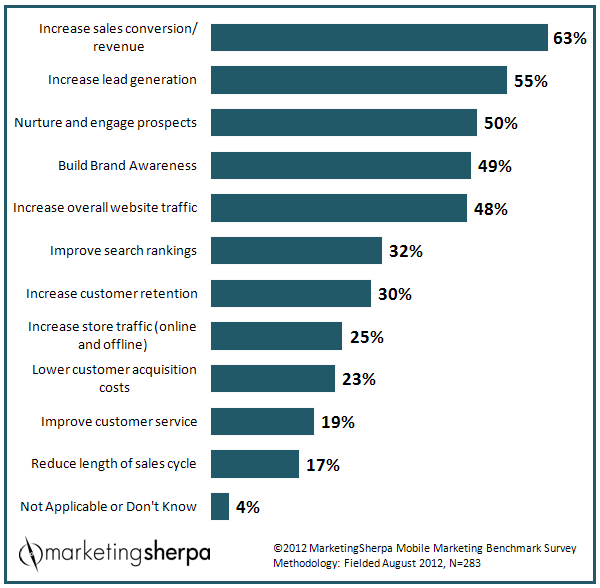
Marketing Research Chart: Top Mobile Marketing Objectives

Whenever marketers begin to investigate the implementation of a new tactic, it’s likely that the first questions asked are, “Why should I do this?” and “What are our goals in doing so?” Mobile is no exception.
When asked about their top objectives, 63% of respondents indicated they hoped to increase sales conversion, followed by increasing lead generation (55%) and lead nurturing (50%). As we learn — somewhat unsurprisingly — in subsequent charts in the Benchmark Report, sales conversion was the top choice for B2C companies, while their B2B counterparts focused on lead generation.
If you’re a B2B marketer, do you see mobile as a viable lead nurturing channel? What types of lead nurturing tactics have you employed in your mobile marketing? What restrictions, if any, have you faced in nurturing leads through mobile efforts?
Despite the fact that increasing sales conversion was a top mobile objective for 63% of marketers, improvement of the customer service experience was a low-ranking category, at just 19%.
Has your company used mobile to improve the customer shopping experience? How have these efforts paid off for your company? Does your company’s approach reflect these findings, or do you feel focusing on the lowest-ranked categories might benefit mobile efforts?